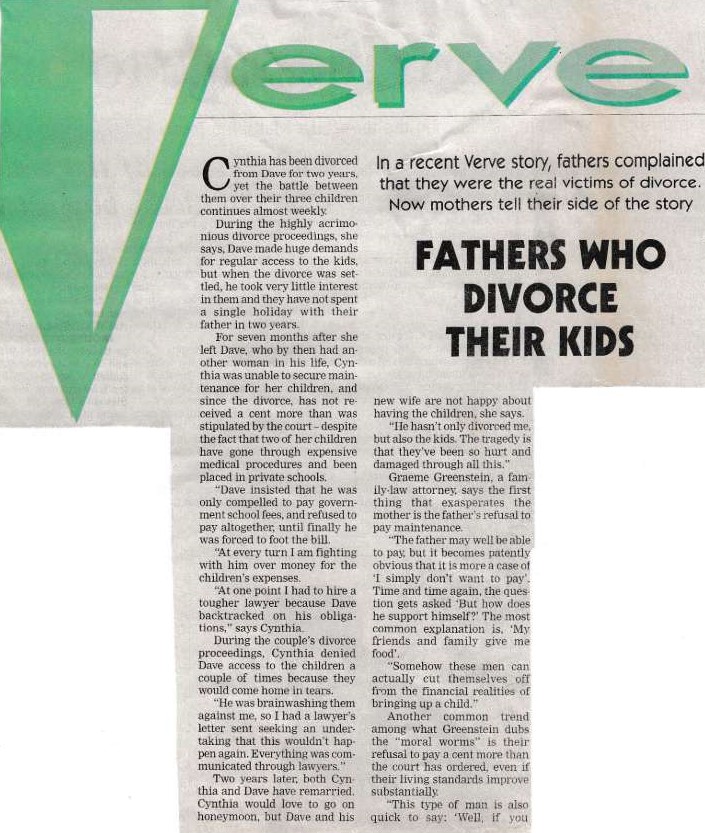
In a recent Verve story, fathers complained from Dave for two years that they were the real victims of divorce. Now mothers tell their side of the story.
Cynthia has been divorced from Dave for two years, yet the battle between them over their three children continues almost weekly. During the highly acrimonious divorce proceedings, she says, Dave made huge demands for regular access to the kids, but when the divorce was settled, he took very little interest in them and they have not spent a single holiday with their Father in two years.
For seven months after she left Dave, who by then had an other woman in his life, Cynthia was unable to secure maintenance for her children, and since the divorce, has not received a cent more than was stipulated by the court – despite the fact that two of her children have gone through expensive medical procedures and been placed in private schools. “Dave insisted that he was only compelled to pay government school fees, and refused to pay altogether, until finally he was forced to foot the bill, “At every turn I am fighting with him over money for the children’s expenses. “At one point I had to hire a tougher lawyer because Dave backtracked on his obligations ,” says Cynthia. During the couple’s divorce proceedings, Cynthia denied Dave access to the children a couple of times because they would come home in tears.
“He was brainwashing them against me, so I had a lawyer’s letter sent seeking an undertaking that this wouldn’t happen again. Everything was com. municated through lawyers. Two years later, both Cynthia and Dave have remarried. Cynthia would love to go on honeymoon, but Dave and his new wife are not happy about having the children, she says.
“He hasn’t only divorced me. but also the kids. The tragedy is that they’ve been so hurt and damaged through all this. Graeme Greenstein, a family law attorney, says the first thing that exasperates the mother is the father’s refusal to pay maintenance. “The father may well be able to pay, but it becomes patently obvious that it is more a case of “I simply don’t want to pay”. Time and time again, the question gets asked but how does he support himself? The most common explanation is. ‘My frlends and family give me food”, “Somehow these men can actually cut themselves off from the financial realities of bringing up a child. Another common trend among what Greenstein dubs the “moral worms” is their refusal to pay a cent more than the court has ordered, even if their living standards improve substantially This type of man is also quick to say: “Well, if you can’t manage financially. I will look after the children.” This is designed to instil fear in the mother.
“Among those who don’t pay maintenance it has always amazed me how they have cell-phones, smoke cigarettes, arrive at court in vehicles and, when questioned about this, it is always “ a friend of mine is supporting me”. “Dave’s sudden wane in interest in his children is another typical characteristic in moral worms,” says Greenstein. “I am sometimes confronted with the situation where one parent wants custody come what may no matter what!”
“Upon investigation, I find that this parent is out of town regularly or leads a lifestyle that is not conducive to being a custodian. In Thandi’s case, her husband Sipho’s mistress broke up her family in July and eight months later exercises control over whether and when Sipho sees his children. Sipho, having reneged on maintenance payments for the initial few months of the break-up, has since bought a townhouse – yet funds for his children are sparse and irregular. “My kids are devastated. In the early months they rejected their father but now they want to see him. They saw him once before going back to school. Children seem to mean nothing to these guys,” says Thandi. In all moral worms, Greenstein says, the common characteristics are selfishness; and an inability to deal with real issues such as clothing, feeding and emotionally nurturing their children; and a penchant for blaming everyone but themselves. “People need to realise that stubbornness, anger and self-pity are not ingredients. for bringing up children, says Greenstein. “The attitudes of a moral worm have devastating repercussions. On a macro level we are heading for a welfare epidemic. On a micro level, children feel unwanted, unloved and malnourished.
“The time has come to stand up and fight for the children single-mindedly and not to let personal differences retard this process.” he says.
AN ATTORNEY’S ADVICE TO DIVORCED PARENTS
- Agreements on the non-custodian’s role should be made and documented. An ugly divorce can be avoided if a spirit of co operation and objectivity prevails.
- A big fear of non custodians is that their ex-spouses will relocate. The custodian must acknowledge this and consent to give notice of any intention to move.
- As long as there is no abuse. parents who do not have custody should have liberal rights of access. Divorce agreements stipulate the minimum, but if the parties are able to expand on thi, it will result in a healthy post-divorce scenario, Stubbornness can easily derail the negotiation process, resulting in prolonged divorce, a diminished bank account and children needing psychological help.
- Maintenance should never be limited to what the courts stipulate but, as much as is possible, to what is within your means. The more you give your child, the better. Timeous payment and realistic budgeting should never be an issue.
- If the non-custodian feels that maintenance is not being spent on the children, divorce agreemerits can be structured to ensure that he/she is responsible for fixed expenses related to the child, eg school fees, books, uniforms, etc.
- Involving children in smear campaigns causes confusion and hurt. Parents must remember that they have immense power. By coming to amicable solutions they can alleviate much suffering.
- The routine children so badly need is disrupted when they suddenly have two homes. It is best to negotiate that furniture which is familiar to the children should follow the custodian. For the balance, the easiest way to distribute it may be for each party to choose one item at a time. Appliances like washing machines should go to the custodian who has to take care of day-to day laundry.
Source: Graeme Greenstein