It’s a sad reflection on our society that one in every four women is in an abusive relationship. Last month, the new Domestic Violence Act came into effect, giving battered women a level of legal protection previously unheard of
– BY PAM SHERRIFFS
It wasn’t long after her fairy-tale wedding to her businessman husband John*, that ‘ for better or worse’ turned into ‘worse than she could have imagined’ for Sarah Jacobs*. One evening she’d been to a function and got home later than she’d planned because her lift had arrived late. The couple who’d given her a lift went inside the house to explain to John what had happened.
To them, he was pleasant and said, “that’s no problem”. It was a different story when they left. As Sarah was getting into a bath, he attacked her from behind, beating her so badly that she fell and broke her knee.
Afterwards, he apologised and promised it wouldn’t happen again – but it did, over and over. He‘d want sex and Sarah would consent, terrified of his reaction if she refused. The next day he’d buy her expensive gifts – once even a smart car.
She’d feel as if she were being bought when she accepted the gifts, but at least peace would reign for a week or so.
John’s monstrous outbursts were sparked off by the most trivial things: she’d ‘omitted’ to tidy up some papers; she’d cooked him ‘the wrong meal’; she’d ‘questioned his judgement’ by suggesting they return some videos.
Like so many abusive partners, John would blame Sarah for causing the fights. ‘All you had to do was shut up and none of this would have happened,’ he’d say.
‘You pushed me too far’.
In the initial stages of their marriage, Sarah actually believed she was to blame and that she could fix things by being ‘nice’ and keeping the house spotless. But however hard she tried, it wasn’t enough.
It took her 10 years to realise that she wasn’t responsible for John’s unstable emotions and that living on her own, in a small house, with few possessions, was preferable to a life of luxury with him.
Her divorce is in the process of being finalised. Sarah’s now the happiest she’s been in a decade and immensely relieved at having finally made the break with John, but she’s still furious at the lack of support and protection from the police during her years of abuse. She’s forgotten the details of most of the beatings, but one stands out in her memory.
She was awakened at about 3am by a punch in her face – her baby was lying next to her in the bed. Amazingly, she managed to summon the police. When they arrived, John was still trying to beat her, but they left her alone with him all the same, saying they couldn’t take her to her father’s house because it ‘wasn’t in their jurisdiction’.
That night, John dragged Sarah from under the children’s bed, where she was hiding, and continued beating her until, eventually he threw her out of the house and locked the door.
‘I stopped going to the police because there was no point,’ she says. ‘Sometimes they’d laugh at me, saying a woman gets beaten when she doesn’t listen to her husband. Even when I got a court order instructing John to allow me into the house to collect some belongings, he refused, and the police said they couldn’t force him to. The court order wasn’t worth the paper it was written on, and he knew it’.
Literally millions of women in South Africa are trapped in abusive relationships. Most suffer in silence, unable to break free – and like Sarah, many at one stage or another have been let down by the police.
The new Domestic Violence Act is intended to change all that. The Act, which is designed to protect victims and prevent further abuse, obliges the police to assist victims of domestic violence when incidents are reported.
Once called out, the police have to arrest the abuser if he’s defied a protection order. Even if there’s no protection order but they suspect abuse has occurred, they are empowered to arrest the perpetrator, thereby removing the possibility of renewed assaults once they’ve left. They can also take away his gun, if he has one.
By law, the police have to help the victims of domestic violence make arrangements for suitable shelter and medical treatment.
They must also provide information in the victim’s language and advise her of her legal options. Any SAPS member who doesn’t comply with the terms of the Act can be disciplined.
‘Unlike in the previous Act, here it is very clear what the role and responsibility of the police are,’ says Nthabiseng Mogale, director of People Opposing Women Abuse (Powa).’ ‘Domestic violence’ used to mean physical assault only, but the new Act takes the definition much further. Stalking, harassment and intimidation are now also offences. ‘It’s hoped that this will reduce the number of death’, says Johannesburg-based family law attorney Graeme Greenstein. ‘In the past, the police had to wait until a crime had been committed before they could take any action.’ The Act also provides legal protection against emotional and psychological abuse.
In Sarah’s case, the emotional abuse was just as intense as the physical beatings. John had initially been attracted to her because of her strength and intelligence, but as soon as they were married he started trying to break her down. He’d swear at her and call her stupid and worthless. Under the new law, such verbal abuse could lead to arrest.
‘Economic abuse’ is also outlawed in the new Act. For example, a husband can no longer intentionally withhold money that’s needed for his family’s well being. Abusers are often miserly – it’s part of their strategy to control their victims, says Greenstein – and just as often women remain in an abusive relationship because they can’t afford to leave. Now the court can order the abuser to pay emergency financial relief to cover such things as relocation, accommodation, mortgage bonds, living expenses and medical bills. Under the new law, abused partners should no longer be financial prisoners.
Another aspect of the new Act is the broadening of the definition of ‘domestic relationships’. In the past, family-violence laws applied to married couples or unmarried couples who lived together. The new Act also include same-sex partners (irrespective of marriage); parents of a child or persons having a parental responsibility; family members related by blood, affinity or adoption; people in a romantic or sexual relationship, including dating or a customary relationship; and people who recently shared a home. In Nthabiseng Mogale’s words, ‘Nobody has a right to abuse anyone any more’.
Part of the cycle of abuse is that women often report their abusers to the authorities only to withdraw the charges later. The new Act stipulates that only the Director of Public Prosecutions can withdraw such charges.
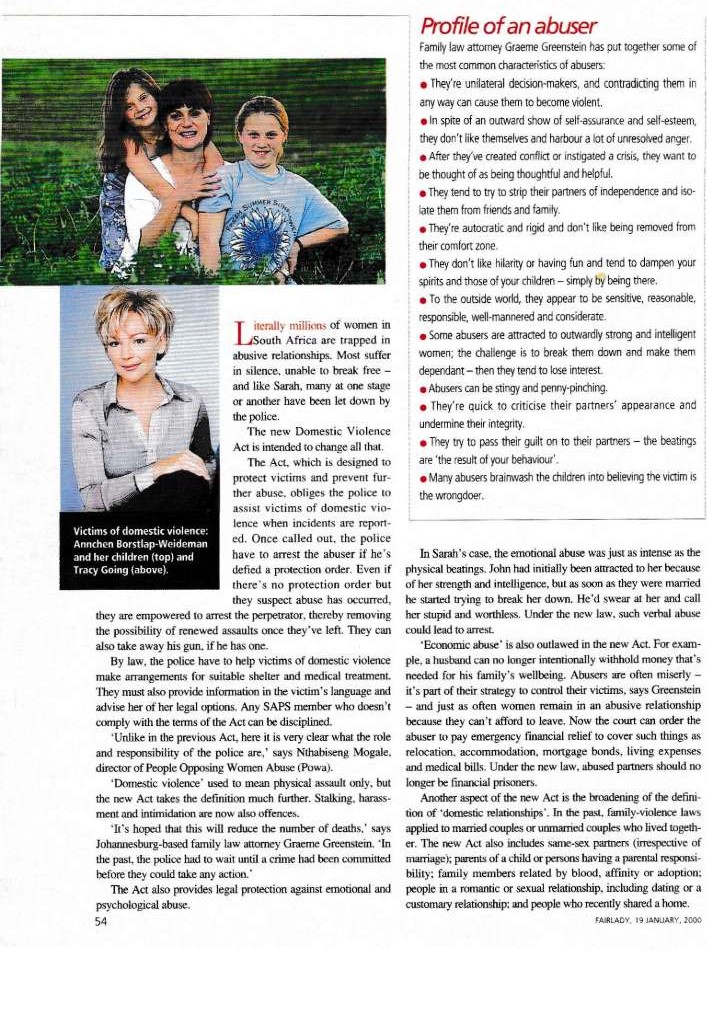
For Annchen Borstlap-Weideman, the Cape Town woman who, last September, spoke out in FAIRLADY about the abusive relationship she was in for years, this is a huge step forward in the fight against domestic violence. Scarred but also strengthened by her ordeal, Annchen now campaigns for women to leave abusive partners. “An experienced abuser knows his partner’s too scared to go through with charges, especially if he’s managed to isolate her sufficiently from the support of others,” she says. “I can’t even remember how many times I dropped charges out of fear of the consequences.”
Greenstein agrees. “Husbands tend to say, ‘Here’s a diamond ring, darling. It was an act of madness, let’s forget about it,” and the wife withdraws the charge and the cycle continues,” he says. “That can’t happen anymore.”
Under the new law, partners may not destroy each other’s property and possessions in a fit of rage, or with malicious intent. It’s also an offence to enter the complainant’s residence without consent if the parties don’t live under the same roof. The courts may prohibit a respondent from entering parts of a shared property. An abuser may be barred by the courts from contacting the children, or be allowed only controlled contact.
Anti-abuse campaigners have hailed the Act as progressive, but concerns have been expressed about the practicalities of implementing it. Says Greenstein, “First, you need a change of attitude by the police and public prosecutors, who until now have been far too quick to say, “Dis huismoles” and ignore it. If the police and the courts broadcast the message, loud and clear, that domestic violence is unacceptable; the chances are good that the Act will be effective.
“Once people believe the system can actually help them, we will no longer have to contend with the arrogant attitude so typical of abusers. But if this doesn’t happen, victims and abusers alike will know the law has no teeth.”
Television personality Tracy Going, whose harrowing story of domestic abuse was covered extensively in FAIRLADY (January 20, 1999), numbers among those concerned about exactly how existing mind-sets in the SAPS and judicial system will be changed. “For me, going through the courts has almost been worse than the initial abuse,” she says. “I believe we need special courts, with magistrates trained to deal with cases of domestic abuse, if we are to prevent the secondary abuse that can occur in the judicial system.”
The new Act doesn’t directly affect the sentencing of abusers (this falls under the criminal law system), but it’s hoped that the Act could influence the way the courts view people convicted of domestic violence, thereby increasing the severity of the sentences meted out.
*Not their real names
PROFILE OF AN ABUSER
Family law attorney Graeme Greenstein has put together some of the most common characteristics of abusers:
- They’re unilateral decision-makers, and contradicting them in any way can cause them to become violent.
- In spite of an outward show of self-assurance and self-esteem, they don’t like themselves and harbour a lot of unresolved anger.
- After they’ve created conflict or instigated a crisis, they want to be thought of as being thoughtful and helpful.
- They tend to try to strip their partners of independence and isolate them from friends and family.
- They don’t like hilarity or having fun and tend to dampen your spirits and those of your children – simply by being there.
- To the outside world, they appear to be sensitive, reasonable, responsible, well mannered and considerate.
- Some abusers are attracted to outwardly strong and intelligent women; the challenge is to break them down and make them dependant – then they tend to lose interest.
- Abusers can be stingy and penny-pinching.
- They’re quick to criticise their partners’ appearance and undermine their integrity.
- They try to pass their guilt on to their partners – the beatings are ‘the result of your behaviour’
- Many abusers brainwash the children into believing the victim is the wrongdoer.
THE NEW MAINTENANCE ACT
Another progressive law that helps women overcome economic abuse is the new Maintenance Act, which came into effect last November. Geared at helping women who battle to get maintenance payments from the fathers of their children, the Act deals with some problems not addressed before- such a defaulters not turning up for court hearings or not being traced. The courts can now grant a maintenance order by default if they’re satisfied the respondent knew he was supposed to appear at a hearing.
The Act provides for the appointment of maintenance investigators to locate recalcitrant fathers, serve papers on them and take statements regarding their financial status from relevant people. (The Department of Justice is currently investigating cost-effective ways to do this.)
There’s also a civil enforcement mechanism, which means the execution of a maintenance order no longer depends on the defaulter’s being arrested and prosecuted criminally. The court can also order employers to deduct payments from a defaulter’s salary.
Although an interim measure, the new Act begins a much-needed reform process of the child maintenance system, and is a big step towards ending the culture of impunity which has for a long time made many mothers’ and children’s lives a misery.