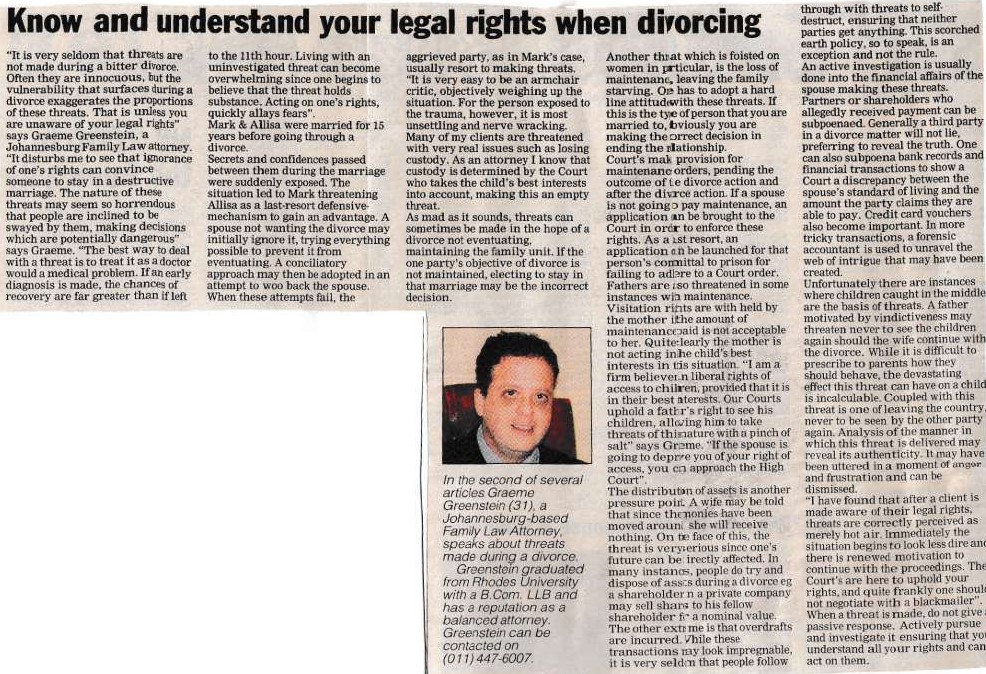
“It is very seldom that threats are not made during a bitter divorce. Often they are innocuous, but the vulnerability that surfaces during a divorce exaggerates the proportions of these threats. That is unless you are unaware of your legal rights” says Graeme Greenstein, a Johannesburg Family Law attorney.
“It disturbs me to see that ignorance of one’s rights can convince someone to stay in a destructive marriage. The nature of these threats may seem so horrendous that people are inclined to be swayed by them, making potentially dangerous decisions” says Graeme.
“The best way to deal with a threat is to treat it as a doctor would a medical problem. If an early diagnosis is made, the chances of recovery are far greater than if left to the 11th hour. Living with an uninvestigated threat can become overwhelming since one begins to believe that the threat holds substance. Acting on one’s rights quickly allays fears”.
Mark & Allisa were married for 15 years before going through a divorce. Secrets and confidences passed between them during the marriage were suddenly exposed. The situation led to Mark threatening Allisa as a last resort defensive mechanism to gain an advantage. A spouse not wanting the divorce may initially ignore it, trying everything possible to prevent it from eventuating. A conciliatory approach may then be adopted in an attempt to woo back the spouse.
When these attempts fail, the aggrieved party, as in Mark’s case, usually resort to making threats. “It is very easy to be an armchair critic, objectively weighing up the situation. For the person exposed to the trauma, however, it is most unsettling and nerve-wracking.
Many of my clients are threatened with very real issues such as losing custody. As an attorney I know that custody is determined by the Court which takes the child’s best interests into account, making this an empty threat. As mad as it sounds, threats can sometimes be made in the hope of a divorce not eventuating, or maintaining the family unit. If one party’s objective of divorce is not maintained, electing to stay in that marriage may be the incorrect decision.
Another that is foisted on women, in particular, is the loss of maintenance, leaving the family starving. One has to adopt a hard-line attitude to these threats. If this is the type of person that you are married to, obviously you are making the correct decision in ending the relationship. Courts make provisions for maintenance orders, pending the outcome of the divorce action and after the divorce action. If a spouse is not going o pay maintenance, an application can be brought to the Court to enforce these rights. As a last resort, an application can be launched for that person’s committal to prison for failing to adhere to a Court order.
Fathers are so threatened in some instances to win maintenance Visitation rights are withheld by the mother the amount of maintenance said is not acceptable to her. Quite clearly the mother is not acting in the child’s best interests in this situation. “I am a firm believer in liberal rights of access to children provided that it is in their best interests. Our Courts uphold a father’s right to see his children, allowing him to take threats of this nature with a pinch of salt” says Graeme. *If the spouse is going to deprive you of your right of access, you can approach the High Court”
The distribution of assets is another pressure point. A wife may be told that since the monies have been moved around she will receive nothing. On the face of this, the threat is very serious since one’s future can be directly affected. In many instances, people do try and dispose of assets during a divorces a shareholder in a private company may sell shares to his fellow shareholder of a nominal value.
The other extreme is that overdrafts are incurred. While these transactions may look impregnable, it is very seldom that people follow through threats to self-destruct, ensuring that neither parties get anything. This scorched earth policy, so to speak, is an exception and not the rule. An active investigation is usually done into the financial affairs of the spouse making these threats. Partners or shareholders who allegedly received payment can be subpoenaed. Generally, a third party in a divorce matter will not lie, preferring to reveal the truth. One can also subpoena bank records and financial transactions to show a Court a discrepancy between the spouse’s standard of living and the amount the party claims they can pay. Credit card vouchers also become important. In more tricky transactions, a forensic accountant is used to unravel the web of intrigue that may have been created.
Unfortunately, there are instances where children caught in the middle are the basis of threats. A father motivated by vindictiveness may threaten never to see the children again should the wife continue with the divorce. While it is difficult to prescribe to parents how they should behave, the devastating effect this threat can have on a child is incalculable. Coupled with this threat is one of leaving the country never to be seen by the other party again. Analysis of how this threat is delivered may reveal its authenticity. It may have been uttered in a moment of anger and frustration and can be dismissed.
“I have found that after a client is made aware of their legal rights, threats are correctly perceived as merely hot air. Immediately the situation begins to look less dire and there is renewed motivation to continue with the proceedings. ‘The Court’s here to uphold your rights, and quite frankly one should not negotiate with a blackmailer”.
When a threat is made, do not give a passive response. Actively pursue and investigate it ensuring that you understand all your rights and can act on them.