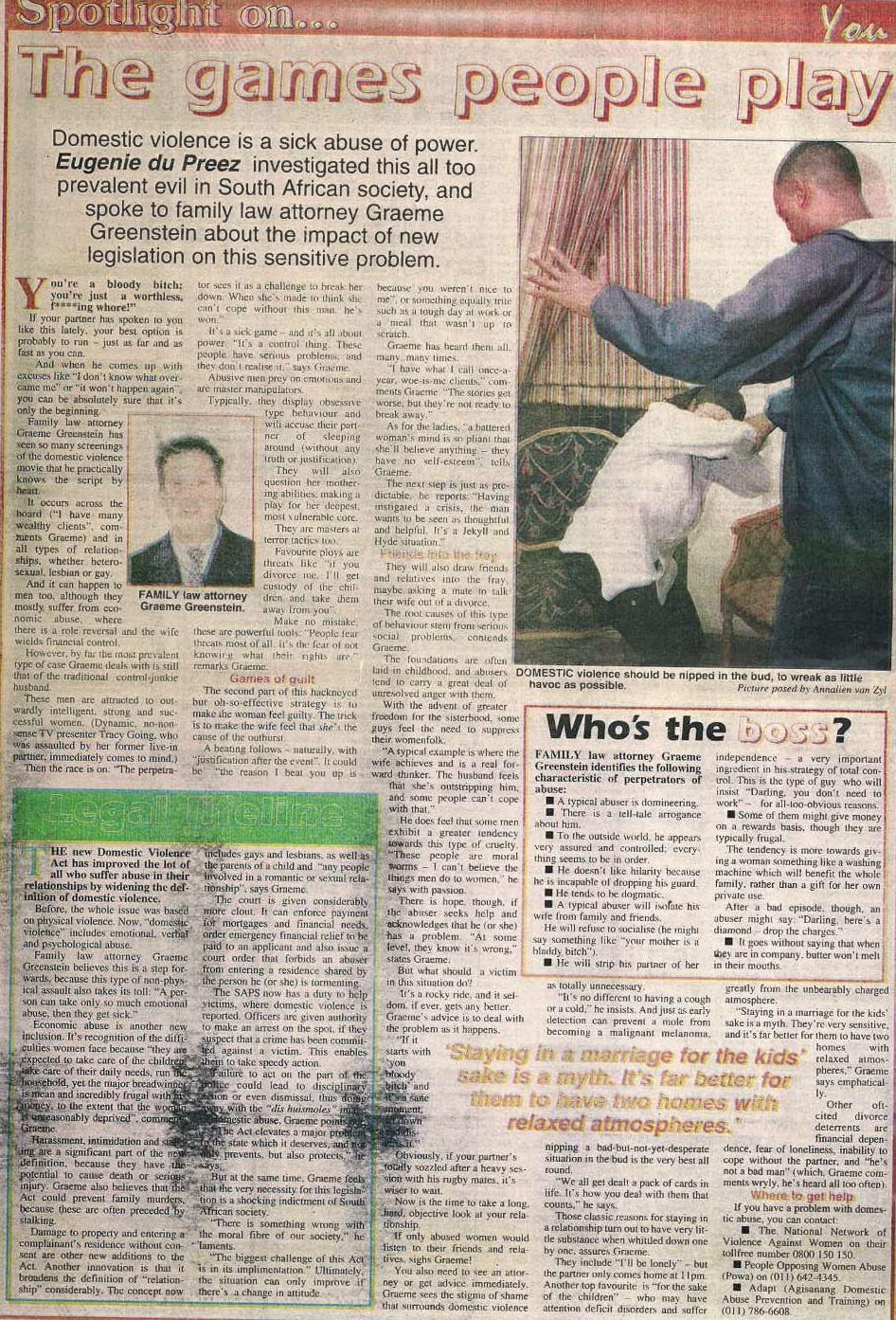
Domestic violence is a sick abuse of power. Eugenie du Preez investigated this all too prevalent evil in South African society, and spoke to family law attorney Graeme Greenstein about the impact of new legislation on this sensitive problem.
You’re a bloody bitch: you’re just a worthless f***ing whore!” If your partner has spoken to you like this lately, your best option is probably to run – just as far and us fast as you can. And when he comes up with excuses like “I don’t know what over came me” or “it won’t happen again you can be absolutely sure that it’s only the beginning. Family law attorney Graeme Greenstein has seen so many screenings of the domestic violence movie that he practically knows the script by heart: It occurs across the board (“I have many wealthy clients” comments Graeme) and in all types of relation. ships. whether hetero-sexual, lesbian or gay. And it can happen to men too. although they mostly suffer from economic abuse where there is a role reversal and the wife wields financial control.
However, by far the most prevalent type of case Graeme deals with is still that of the traditional control-junkie husband. These men are attracted to outwardly intelligent, strong and successful women. (Dynamic, no-nonsense TV presenter Tracy Going, who was assaulted by her former live-in partner, immediately comes to mind,) Then the race is on: “The perpetrator sees it as a challenge to break her down. When she’s made to think she can’t cope without this man, he’s won.”
It’s a sick game – and it’s all about power. “It’s a control thing. These people have serious problems, and the don’t realise it.” says Graeme. Abusive men prey on emotions and are master manipulators. Typically. they display obsessive type behaviour and will accuse their partner of sleeping around (without any truth or justification). They will also question her mothering abilities. making a play for her deepest most vulnerable core. They are masters at terror tactics too. Favourite blows are threats like “if you divorce me lil get custody of the children and take them away from you.” Make no mistake these are powerful tools: “ People fear threats most of all. It’s is the fear of not knowing what their rights are,” remarks Graeme.
Games of guilt
The second part of this hackneyed but oh-so effective strategy is to make the woman feel guilty. The trick is to make the wife feel that she the cause of the outburst. A beating follows – naturally, with “justification after the event”. It could be “the reason I beat you up is because you weren’t nice to me”, or something equally true such as it’s a tough day at work or a meal that wasn’t up to scratch. Graeme has heard them all, many many times.
“I have what h call once a year, woe-is-me clients” comments Graeme. “The stories get worse, but they’re not ready to break away.
As for the ladies, “a battered woman’s mind is so pliant that she’ll believe anything- they have no self esteem”, tells Graeme.
The next step is just as predictable, be reports “Having instigated a crisis, the man wants to be seen as thoughtful and helpful. It’s a Jekyll and Hyde situation.”
Friends into the fray
They will also draw friends and relatives into the fray, maybe asking a mate to talk their wife out of a divorce. The root causes this type of behaviour from serious social problems, contends Graeme.
The foundations are often laid in childhood, and abusers tend to carry a great deal of unresolved anger with them. With the advent of greater freedom for the sisterhood, some guys feel the need to suppress their womenfolk.
“A typical example is where the wife achieves and is a real forward thinker. The husband feels that she’s outstripping him and some people can’t cope with that.” He does feel that some women exhibit a greater tendency towards this type of cruelty. “These people are moral worms- I can’t believe the things men do to women.” He says with passion. There is no hope though, if the abuser seeks help and acknowledges that he (or she) has a problem. “At some level, they know it’s wrong,” states Graeme.
But what should a victim in this situation do? It’s a rocky ride and it seldom if ever gets any better. Graeme’s advice is to deal with the problem as it happens. Obviously, if your partners totally sozzled after a beach session with his rugby mates, it’s wiser to wait. Now it’s time you take a long hard look at your relationship. If only abused women would listen to their friends and relatives, sighs Graeme. You also need to see an attorney or get advice immediately. Graeme sees the stigma of shame that surrounds domestic violence as totally unnecessary. “It’s so different to having a cough or a cold.” He insists. And just as early detection can prevent a mole from becoming a malignant melanoma nipping a bad-but-not-yet- desperate situation in the bud is the very best all round.
“Staying in a marriage for the kids sake is a myth. It’s far better for them to have two homes with relaxed atmospheres.”
“We all get dealt a lack of cards in life. It’s how you deal with them that counts, he says. Those classic reasons for staying in a relationship turn out to have very little substance when whittled down one by one, assures Graeme. They include “I’ll be lonely”- but the partner only comes home at 11pm. Another too favourite is “for the sake of the children”- who may have attention deficit disorders and suffer greatly from the unbearably charged atmosphere. “Staying in the marriage for the kids” sake is a myth. They’re very sensitive and it’s far better for them to have two homes with relaxed atmospheres.” Graeme says emphatically. Other often cited divorce deterrents are financial dependence, fear of loneliness, inability to cope without a partner, and “he’s not a bad man” (which Graeme comments wryly, he’s heard all too often)
Where to get help?
- The national network of violence against women at 0800 150 150
- People opposing woman abuse(POWA): 011 642 4345
- Adapt on 011 786 6608
If you have problem with domestic abuse, you can contact: